Wednesday, 14 September 2016
1. Google Driverless Cars
we will soon have smart cars around. In June 2014, Google launched its 'Android Auto', a telematics software that can be connected to car dash board for infotainment. It also enables the driver to access GPS, maps, streaming music, weather, and a host of other applications. A slew of carmakers including Abarth, Acura, Alfa Romeo, Audi, Bentley, Chevrolet, Chrysler, Dodge, Fiat, Ford, Infiniti, Jeep, Kia, Maserati and Volvo will offer Android Auto in their cars
Hero MotoCorp introduced its first bike with start-stop technology, Splendor iSmart, in March 2014.
Toyota is developing a future airborne car. A media report quoted Hiroyoshi Yoshiki, managing officer at Toyota Motor Corporation, as saying the company has been toying with the idea of flying cars.
Saturday, 10 September 2016
3 Emerging Trends in
Automotive Engineering
Not too many people know automotive trends the way the staff does at The Ohio State University's Center for Automotive Research (OSU CAR). This interdisciplinary research center at OSU's College of Engineering focuses on advanced electric propulsion and energy storage systems, engines and alternative fuels, intelligent transportation and vehicular communication systems, autonomous vehicles, vehicle chassis systems, and vehicle safety.
"One of the biggest trends right now in automotive engineering is improving engine efficiency and fuel economy," says Giorgio Rizzoni, director of OSU CAR. "This includes downsizing, down-speeding, direct fuel injection, and boosting."
Other engineering trends focus on improving transmissions (adding speeds), accessory load reduction through the intelligent energy management of other vehicle components, vehicle electrification, hybridization, improved battery management systems, new battery chemistries, and power electronics.
"Weight reduction in vehicle subsystems is also being tested by using lightweight structures made from alternative materials such as aluminium, magnesium, composites, plastics, and multi-material construction," adds Rizzoni.
Battery management systems are being designed to meet performance, life, and warranty goals for both batteries and their monitoring and management systems. "Automakers need to fully understand how varying operational limits affect the life of battery systems through extensive testing and modeling, followed by developing sophisticated algorithms to track and predict various parameters, such as state of charge and state of health through the life of the battery," comments Rizzoni.
In order to expand battery operating range and reduce costs, some researchers are designing and testing new battery chemistries and subsystems. Advanced chemistries could allow batteries to operate through greater temperature extremes, last longer, and reduce weight and cost. Other efforts are being made to reduce the cost of the ancillary systems, such as cooling, to further reduce the total cost of the battery system.
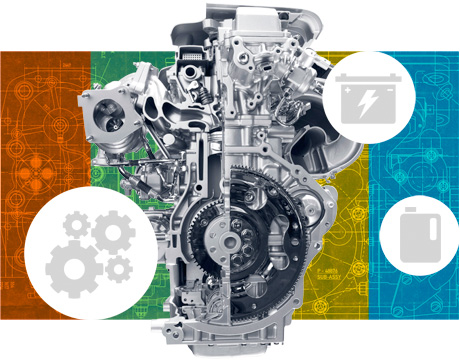
Downsized engines are lighter than conventional engines, thereby reducing vehicle mass and the improving vehicle fuel consumption. Turbocharging recovers the energy of the exhaust gasses to increase the inducted charge, therefore increasing the power-to-displacement ratio. "A downsized and turbocharged engine has the potential to have the same or better performance as a non-downsized, normally aspirated engine, with the advantage of a significant increase of fuel efficiency," says Rizzoni.
Another research trend targets ways to recover the energy that is normally dissipated through the coolant and the exhaust gas systems of automotive powertrains using innovative waste heat recovery devices. These systems can convert thermal energy into mechanical or electrical energy, thus increasing the overall efficiency of the vehicle. Organic Rankine cycle, thermoelectric systems, turbo compounding, and recuperative thermal management systems all have potential for significantly increase engine efficiencies.
A smaller but still significant aspect of fuel-efficiency research is called "intelligent energy management." "This ability to more intelligently control the accessory loads in a vehicle—such as the alternator or power steering, etc.—will also contribute to better gas mileage," says Rizzoni. "With smarter control of these loads and the addition of stop-start technology there can be significant increases in fuel economy, with small or no increase in total vehicle cost."
Automotive Engineering
Current trends in automotive engineering largely focus on improving engine efficiency and fuel economy.
"One of the biggest trends right now in automotive engineering is improving engine efficiency and fuel economy," says Giorgio Rizzoni, director of OSU CAR. "This includes downsizing, down-speeding, direct fuel injection, and boosting."Other engineering trends focus on improving transmissions (adding speeds), accessory load reduction through the intelligent energy management of other vehicle components, vehicle electrification, hybridization, improved battery management systems, new battery chemistries, and power electronics.
"Weight reduction in vehicle subsystems is also being tested by using lightweight structures made from alternative materials such as aluminium, magnesium, composites, plastics, and multi-material construction," adds Rizzoni.
Battery Systems
Battery management systems are being designed to meet performance, life, and warranty goals for both batteries and their monitoring and management systems. "Automakers need to fully understand how varying operational limits affect the life of battery systems through extensive testing and modeling, followed by developing sophisticated algorithms to track and predict various parameters, such as state of charge and state of health through the life of the battery," comments Rizzoni.In order to expand battery operating range and reduce costs, some researchers are designing and testing new battery chemistries and subsystems. Advanced chemistries could allow batteries to operate through greater temperature extremes, last longer, and reduce weight and cost. Other efforts are being made to reduce the cost of the ancillary systems, such as cooling, to further reduce the total cost of the battery system.
Downsizing and Turbocharging
The two main benefits in downsizing an internal combustion engine are thermodynamic and mechanical. "From a thermodynamic point of view, the engine operation will move towards higher loads, at which the engine efficiency is higher," says Rizzoni. "From the mechanical point of view, the positive aspect lies in the reduction of the friction in the piston units, together with the reduction of the number of cylinders."Downsized engines are lighter than conventional engines, thereby reducing vehicle mass and the improving vehicle fuel consumption. Turbocharging recovers the energy of the exhaust gasses to increase the inducted charge, therefore increasing the power-to-displacement ratio. "A downsized and turbocharged engine has the potential to have the same or better performance as a non-downsized, normally aspirated engine, with the advantage of a significant increase of fuel efficiency," says Rizzoni.
Advanced Combustion Modes
Engineers are working to increase the efficiency of internal combustion engines by developing several advanced combustion modes. One of these modes is called (homogeneous charge compression ignition) HCCI. In the HCCI combustion, a highly homogenized mixture of air, fuel, and combustion products from the previous cycle is auto-ignited by compression. "This combustion mode aims at combining the advantages of modern diesel and gasoline combustion processes, namely low emissions and high efficiency," states Rizzoni.Another research trend targets ways to recover the energy that is normally dissipated through the coolant and the exhaust gas systems of automotive powertrains using innovative waste heat recovery devices. These systems can convert thermal energy into mechanical or electrical energy, thus increasing the overall efficiency of the vehicle. Organic Rankine cycle, thermoelectric systems, turbo compounding, and recuperative thermal management systems all have potential for significantly increase engine efficiencies.
A smaller but still significant aspect of fuel-efficiency research is called "intelligent energy management." "This ability to more intelligently control the accessory loads in a vehicle—such as the alternator or power steering, etc.—will also contribute to better gas mileage," says Rizzoni. "With smarter control of these loads and the addition of stop-start technology there can be significant increases in fuel economy, with small or no increase in total vehicle cost."
Tuesday, 6 September 2016
10 tips for car designers
1 – The design industry of today
PL: Today’s design world is much more complex: students need to be internationally open. Even if the history of design is traditionally cantered on Europe and United States, the future will have no boundaries.This is an extremely important aspect, as you will be involved in international design environments. Competition will be open worldwide and not just among three or four design schools in Europe or in the States.
Things are evolving very quickly: in emerging countries like India, today it is possible to find competences that could not be found just five years ago.
LB: I had the chance to attend the Art Centre College of Design in 1984, and I came back and started working in Italy in 1989. Three years later I began teaching car design.Back then, the first European design schools were just opening, conscious of the importance of providing a transportation design specific education, in competition with the long established schools in the United States and in Japan.
Today we have a lot of new design schools and in emerging countries like China there are also a few State universities offering transportation design courses: they are doing extremely well in a very short period of time.
When I started teaching in Italy, we launched the first transportation design department in Turin, and it took us almost eight years to reach a very high quality. Today design schools in China have managed to achieve a remarkable results in just three years.
Today competition is much, much higher.
2 – Open mind
PL: Sometimes it’s difficult for young creative to realize they don’t work alone: the basis of creativity lies in the designer’s personality, however while in the past this could have been enough, it is not enough today.In the professional world it usually takes 4 to 5 years to young designers in order to be operational within a team. During this period they are requested to interact with different competencies and mind-sets.
It is important to find the right balance between having a strong personality and a charismatic attitude – which are necessary to build a creative mind – while being open minded towards diversity and not being too egocentric.
LB: In order to get a job in the car design industry you’ll need to be able to integrate in a team a lot faster than it used to be back in my times.
Today students cannot focus solely on sketching and rendering ability – which are still essential skills; they have to become manager of themselves in order to be able to manage projects and be autonomous.If you want to survive in this competitive field, you need to be open to everything during all your career, not just during the time spent at school and internships.
3 – Teamwork
PL: Don’t forget: automotive design is teamwork. It’s difficult for us designer – especially when we are young – to accept we are not at the centre of the universe.Being proud of yourself and having your own ideas are necessary aspects, but a vehicle is so complex that it will never be only your own success.
4 – Time management
LB: Having good drawing and modelling skills is essential, but the most important thing – as a student and as a future designer or design manager – is being able to respect deadlines.
When you are in design school, you are not much concerned about time. You want to be the best, so it is important to show the teacher or the client a very good sketch or a perfect model.But when you are in the real world and you are facing a deadline, it’s quite different.
And often the most talented and artistic designers are the ones who have the most difficulties.
However, this difficulty can be reversed and time can become your best friend when seen in a constructive way: it can motivate you and can help you to find the best solutions given the constraints and the tools you have at your disposal.
PL: [In order to succeed] you need to make a proper analysis first, and then ideas will come quickly. After that, you have to carefully choose one clear idea and go for it. Don’t spend too much time tuning the idea or trying to deliver perfect quality.
5 – Selling ideas and presenting projects
PL: The cleverness of a new concept is obviously the most important aspect of a design project, but often young designers underestimate the importance of selling their work – whether to a teacher or to a final customer.
A new product will not produce emotions spontaneously: you’ll have to make people react emotionally and this is a very important aspect of a designer’s job.
For example, during business meetings you will face very busy top managers and it is crucial to catch their attention by creating an “advertising” on screen, better if with a short story behind, with some music and a scenario: if you manage to do it, then you “have won half the battle”.
When presenting a project to a teacher or to an interviewer, focus on one or two messages, and no more. Don’t get “everywhere”: be focused, choose and be efficient.
6 – Making design decisions
PL: When you create a new product or concept you need to think about what it is for and what it is not for, what you want to achieve and what you don’t want to achieve.Making these choices will allow you to create something that gives answers to specific questions.
Don’t try to solve all problems, make choices, even if this can be difficult for designers. If you are able to make the right choices you will create a successful product, otherwise you are very likely to end with an average result.
7 – Hand modeling
LB: Today with digital CAD models we can arrive up to 90% of the product. When you have milled a model and you put your hands on it, you will always find out areas that need changes; and when you apply a layer of paint on it, sometimes you’ll realize that reflections are not as you had imagined.In those cases you’ll have to sculpt and work with clay: it is still a very special, artistic aspect of a designer’s talent that computers simply can’t do.
8 – Honest design
PL: Don’t over-promise by design, be honest with your customers. Don’t design a car that looks fast if it isn’t.9. Being Curious
PL: We don’t have to overestimate our role of designers: we have the ability of visualizing ideas by sketching and prototyping, while engineers, market researchers, managers have different yet very important skills.When you start you usually have little knowledge of these fields, and that’s something you can develop with time.
As a designer you’ll need to be curious and look at everything: engineering basics, international trends, fashion, graphic design, customer satisfaction. This will allow you to understand enough to put the elements together and to concretize the ideas.
10 – Training creativity
PL: Creativity is not spontaneous. Like every other skill, creativity needs to be trained during the whole life.Monday, 5 September 2016
Automobile Engineer
Who This Career is For?
A career as an automobile engineer is for people who are driven and passionate about cars. They must have considerable understanding and interest in mechanics, electronics, and mathematics as these are vital skills required for this career path. Automobile engineers must be organized individuals who are able to work in a methodical manner.
People in this career are required to communicate with other professionals on a regular basis, both from within the field and outside it. Hence, this career is only for those with fluent communication skills. While automobile engineers must be innovative, eager workers, they must not get carried away.
Want to know more about it?
Automobile engineers hold a wide variety of responsibilities. Their primary purpose is to maximize the feasibility and design of automobiles keeping costs to an absolute minimum.
A typical professional in this field spends a lot of time on researching and designing both systems and machines for automobiles. The designs are initially done in the form of drawings and blueprints. Automobile engineers then apply physical and mathematical principles to these plans to make sure they are viable. The planning is done after considerable research, and then altered again after linking the plans to the available research.
Once the planning process is done, the designing begins. Automobile engineers are responsible for transforming their plans and research into a viable end product. They must oversee the entire process of manufacturing, with meticulous attention to detail.
After the end product is manufactured, the most important part of an automobile engineer’s job begins. Testing is a rigorous process that must be done with utmost care. This procedure generally entails focusing on each and every component of an automobile to ensure it is able to function in every imaginable condition in a safe and secure manner.
Automobile engineers generally tend to specialize in a particular area. The most common areas of specialization include exhaust systems, engines and structural designs. No matter what an engineer decides to specialize in, he or she is almost always required to work on all three aspects of the automobile engineering process; research, designing as well as testing.
There is also often a financial side to this job, which involves preparing costs of buying materials and producing systems. It is also important to realize the legal aspects of this job. Automobile engineers must be up to date with all safety regulations, so that they do not violate legislation related to automobile engineering procedure.
Automobile engineers generally know they want to get into the field at a fairly young age, so they are generally people who studied natural sciences and mathematics in high school. This gives them the edge to get a degree in engineering, which is an essential prerequisite to become an automobile engineer.
Additionally, while it is not necessary, a master’s degree in a field such as automotives or automotive engineering gives prospective automobile engineers a distinct advantage.
A typical professional in this field spends a lot of time on researching and designing both systems and machines for automobiles. The designs are initially done in the form of drawings and blueprints. Automobile engineers then apply physical and mathematical principles to these plans to make sure they are viable. The planning is done after considerable research, and then altered again after linking the plans to the available research.
Once the planning process is done, the designing begins. Automobile engineers are responsible for transforming their plans and research into a viable end product. They must oversee the entire process of manufacturing, with meticulous attention to detail.
After the end product is manufactured, the most important part of an automobile engineer’s job begins. Testing is a rigorous process that must be done with utmost care. This procedure generally entails focusing on each and every component of an automobile to ensure it is able to function in every imaginable condition in a safe and secure manner.
Automobile engineers generally tend to specialize in a particular area. The most common areas of specialization include exhaust systems, engines and structural designs. No matter what an engineer decides to specialize in, he or she is almost always required to work on all three aspects of the automobile engineering process; research, designing as well as testing.
There is also often a financial side to this job, which involves preparing costs of buying materials and producing systems. It is also important to realize the legal aspects of this job. Automobile engineers must be up to date with all safety regulations, so that they do not violate legislation related to automobile engineering procedure.
Automobile engineers generally know they want to get into the field at a fairly young age, so they are generally people who studied natural sciences and mathematics in high school. This gives them the edge to get a degree in engineering, which is an essential prerequisite to become an automobile engineer.
Additionally, while it is not necessary, a master’s degree in a field such as automotives or automotive engineering gives prospective automobile engineers a distinct advantage.
What are Salary Prospects?
A graduate engineer at a major OEM (original equipment manufacturer, ie carmaker) gets a stipend of Rs. 28,000 to Rs. 30,000 a month during training. This can go up to Rs. 40,000 till s/he is confirmed. A line leader/assistant manager can earn anything from Rs. 40,000 to Rs. 80,000 a month, depending on their experience in the industry.
According to PayScale India, an automobile engineer can earn anywhere between Rs. 250,000 and Rs. 600,000 per annum including average bonuses and commissions received on the job. The highest salaries were paid by vehicle manufacturers whereas product development engineering firms paid a lot less to automobile engineers they hired. A division head with 18 years’ experience can make anything from Rs. 25 lakh to Rs. 30 lakh per annum.
How is Life?
Automobile engineers work varying hours per week depending on the amount of work they have assigned during a particular week. They may work anywhere between a 40 hour week and a 55 hour week, but may even be required to work overtime if there are some outstanding deadlines or emergencies.
Automobile engineers spend a lot of time in front of a computer on their desks. When they are not doing research in their office, they are at plants monitoring the manufacturing of the automobiles they planned and their testing. This may involve spending lengthy periods of time in noisy, dirty factory environments.
What Perks come along with this career?
Automobile engineering is a career path that no one will deny is unimportant. There are millions of vehicles on roads in every corner of the world, and automobile engineers are the people responsible for that. They feel an immense amount of satisfaction when they see a machine as intricate as a modern automobile completed when they are the ones who contributed towards its design.
Automobile engineers earn a considerable salary, more so than many other types of engineers. They have a fair amount of job security as they begin gaining experience. People in the field are generally passionate about automobiles, and so have the added advantage of working with something they truly appreciate.
Which Downsides are there in this career?
The job often requires automobile engineers to work under the immense pressure of tight deadlines. Moreover, they have the lives of millions of people in their hands as they do their work. The slightest mistakes in planning, designing or testing could be catastrophic.
Automobile engineers often have to deal with noisy factory conditions for extended periods of time. They have to pay scrupulous attention to detail at every aspect of their job, which can often get monotonous.
How is Competition?
While the automobile industry has been on a decline in the past five years in most areas of the world, the number of people who opt for this career is quite low because of the high level of training and specialization required to become successful. As a result, there is a fair amount of competition in the field, especially for the most lucrative jobs. The number of jobs in the field is likely to increase at a slow pace in the next few years.
Locations where this career is good?
In the USA, the Midwest is the best place to be an automobile engineer because of the concentration of automobile manufacturing firms in the region. In Europe, Germany is the leading automobile manufacturer.
There is a large demand for automobile engineers in Japan, South Korea, China and India.
More specifically in India, the Maharashtra province offers the most jobs as well as the highest level of salary in this field. The city of Bangalore is also a good place to be an automobile engineer within India.
There is a large demand for automobile engineers in Japan, South Korea, China and India.
More specifically in India, the Maharashtra province offers the most jobs as well as the highest level of salary in this field. The city of Bangalore is also a good place to be an automobile engineer within India.
Career Path
To become an automobile engineer, After completing Class 12 from the science stream one must have a BE or B.Tech. in automobile engineering. Even degree holders in electrical or mechanical branch can go in for specialization in automobile engineering at the postgraduate level. Diploma holders can take the AMIE exam to be at par with degree holders.
Necessary Qualifications
B.Tech.
B.E.
Saturday, 3 September 2016
Hello everyone....
lets improve our knowledge in automobile engineering by answering some questions?
if any one need clear explination leave your mails on coment box..
| 1. |
The condition that causes vapour locking in a brake system is
| |||||||
|
| 3. |
A baffle plate is fitted inside the oil pan to prevent the oil from splashing when it is subjected to vibration and other movement during vehicle operation.
| |||
|
| 4. |
The motion of the cam is transferred to the valves through
| |||||||
|
| 5. |
Which of the following symptom is caused as a result of brake disc run out ?
| |||||||
|
Thursday, 1 September 2016
best automobile buzz
Hlo every one ,Here u can find the best automobiles technology and reviews,and parts of automobiles.
Lets start...............................,
Starting with fantastic Ferrari.
Native name
|
Ferrari N.V.
| ||||||||||||||||||||||||||||||||||||||||||||||||
|---|---|---|---|---|---|---|---|---|---|---|---|---|---|---|---|---|---|---|---|---|---|---|---|---|---|---|---|---|---|---|---|---|---|---|---|---|---|---|---|---|---|---|---|---|---|---|---|---|---|
| Traded as | |||||||||||||||||||||||||||||||||||||||||||||||||
| Industry | |||||||||||||||||||||||||||||||||||||||||||||||||
| Founded | |||||||||||||||||||||||||||||||||||||||||||||||||
| Founder | |||||||||||||||||||||||||||||||||||||||||||||||||
| Headquarters |
| ||||||||||||||||||||||||||||||||||||||||||||||||
Key people
|
| ||||||||||||||||||||||||||||||||||||||||||||||||
|
| ||||||||||||||||||||||||||||||||||||||||||||||||
| |||||||||||||||||||||||||||||||||||||||||||||||||
Subscribe to:
Comments (Atom)